



Choosing Pure Melatonin Powder for Capsules, Gummies, or Tablets
The right pure melatonin powder for capsules, gummies, or tablets is the one whose assay, particle size, flow properties, and stability are compatible with your dosage form and manufacturing process. Capsules generally require a powder that blends uniformly and flows consistently. Gummies need an ingredient that disperses evenly throughout the formulation and remains stable under the processing conditions. Tablets require suitable particle-size distribution, flowability, and compression performance. For every application, buyers should review a batch-specific Certificate of Analysis (COA), evaluate samples using their own equipment, and compare suppliers against consistent specifications and delivery terms. This guide explains the main considerations to help your team select an appropriate ingredient and assess potential suppliers. It is written for R&D directors, formulation managers, and procurement teams at supplement brands, contract manufacturers, and ingredient distributors.
What Is Pure Melatonin Powder and How Is It Made?
Defining the Ingredient
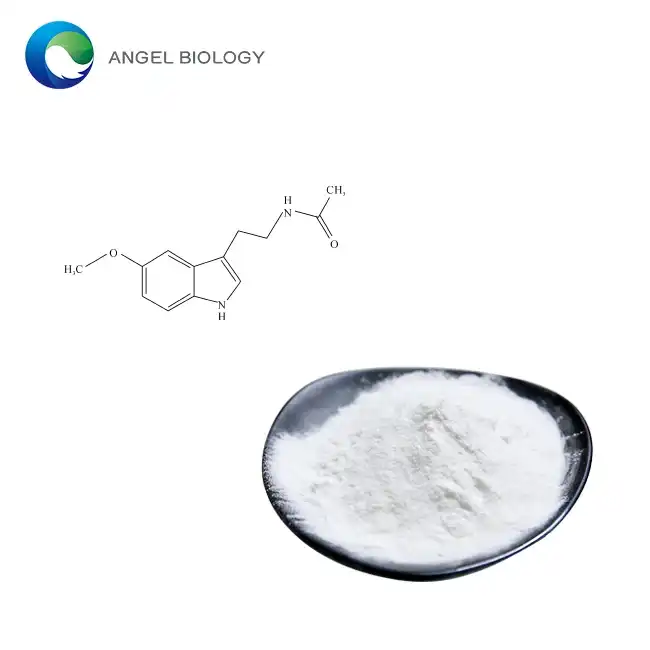
Melatonin, identified by CAS No. 73-31-4, is a compound chemically known as N-acetyl-5-methoxytryptamine. In its pure powder form, it is supplied as an ingredient for use in different formulated products. It should be distinguished from finished beverages, capsules, tablets, and gummies, which may contain additional ingredients such as sweeteners, binders, fillers, flavors, and carriers.
Most commercially available melatonin is produced through chemical synthesis. Therefore, suppliers making claims about a natural origin should be able to provide clear documentation describing the source and manufacturing process. Buyers should also check the ingredient naming, permitted applications, labeling requirements, and import regulations in the destination market before selecting a product specification.
For sourcing and quality evaluation, relevant documentation may include ingredient identification, assay, moisture content, residual solvents, heavy metals, microbiological results, and allergen information where applicable. These details help buyers determine whether the material meets their formulation and market requirements.
Production and Quality Control Stages
Understanding the production process helps buyers assess whether a supplier can provide consistent material across different batches. A typical production workflow may include raw material verification, controlled synthesis, purification, drying, milling or micronization, packaging, and finished-batch testing. The specific process and testing requirements depend on the supplier's manufacturing method and product specification.
During production, important parameters may include chemical identity, assay, related substances, residual solvents, particle-size distribution, and moisture content. Buyers commonly request HPLC data to review ingredient identity, assay, and relevant impurity profiles. However, the test method, reference standard, and reporting basis should be checked before comparing results from different suppliers.
Published research has also identified variations between the labeled and measured melatonin content of certain commercial finished products. A 2017 study in the Journal of Clinical Sleep Medicine, for example, reported variability in the melatonin content of tested products. This finding supports the importance of appropriate ingredient verification and finished-product testing, rather than assuming that a raw material specification alone guarantees the final product's content.
A supplier should be able to explain its batch testing procedures and provide traceable records for the material being offered. Consistent testing methods and clearly defined acceptance criteria make it easier for buyers to compare batches and evaluate long-term supply reliability.
Reading a COA and Purity Claims
Terms such as "high purity," "pharmaceutical grade," and "food grade" should always be supported by measurable specifications and relevant documentation. When evaluating pure melatonin powder, buyers should review the Certificate of Analysis (COA) rather than relying only on promotional descriptions.
Commercial specifications may list an HPLC assay above 99%, while some suppliers may offer higher assay targets. These figures should be confirmed against the actual batch COA and the stated test method. Buyers should also check whether the result is reported on an as-is basis or calculated on a dried basis, as this can affect comparisons.
A useful batch-specific COA should include:
Product name and identification information
Batch or lot number
Manufacturing or testing date, where applicable
Test methods and acceptance criteria
Actual test results and units
Relevant impurity and contaminant results
Authorized review or approval information
A document without a batch number, test date, or identifiable method provides limited evidence for batch evaluation. For projects with stricter documentation requirements, buyers may also arrange independent third-party testing to compare results with the supplier's COA. This can be particularly useful when qualifying a new supplier or preparing for larger-volume procurement.
Choosing Pure Melatonin Powder for Capsules, Gummies, or Tablets
The same pure melatonin powder may be suitable for more than one dosage form, but each application places different demands on the ingredient. Capsules, gummies, and tablets differ in their mixing, processing, and finished-product requirements. Evaluating these applications separately helps manufacturers select a suitable specification.
Capsules
Capsule production requires consistent powder flow and uniform blending. Since the amount of melatonin in a serving may be relatively small compared with the total fill weight, the ingredient needs to be distributed evenly throughout the blend. This makes blend uniformity an important consideration during formulation development.
Powder with poor flow properties may cause inconsistent feeding, bridging, or uneven filling in some equipment. Very fine particles may also increase dust formation or cohesion, depending on the material's physical characteristics. These issues can affect processing efficiency and require adjustments to the formulation or equipment settings.
To evaluate suitability, manufacturers should test the powder with their selected fillers and other excipients. Check bulk density, flow behavior, particle-size distribution, and blend uniformity under actual production conditions. It is also important to confirm that the selected mixing process can maintain a consistent ingredient distribution across the intended batch size.
A sample trial using the planned capsule-filling equipment is more informative than relying on a general statement that a powder is suitable for capsule production. Buyers should assess both the ingredient's physical properties and its compatibility with the complete formulation.
Gummies
Gummy manufacturing involves heat, moisture, and formulation conditions that may influence ingredient stability and distribution. When using pure melatonin powder, manufacturers need to ensure that the ingredient is dispersed uniformly throughout the gummy mixture before molding.
Melatonin has limited solubility in water, so it should not automatically be treated as a water-soluble ingredient. Depending on the formulation, a suitable dispersion method or carrier system may be needed to achieve a consistent distribution. The choice of carrier should be evaluated for compatibility with the gummy base, flavor system, processing temperature, and other ingredients.
Manufacturers should also consider the effects of processing time, pH, moisture, and storage conditions. These variables can differ significantly between gummy formulations, so the stability of the raw material alone cannot establish the shelf life of the finished product.
Finished-product testing should be conducted at appropriate intervals during the proposed shelf life. Testing may include melatonin content, content uniformity, physical appearance, moisture-related changes, and other relevant quality attributes. A 2023 study published in JAMA reported inaccurate melatonin labeling in many of the gummy products examined in the United States. Although this study concerned finished products rather than every commercial raw material, it highlights the value of verifying ingredient input, mixing consistency, and finished-product content.
For gummy manufacturers, a practical evaluation should include dispersion trials, process compatibility checks, and stability testing in the intended packaging.
Tablets
Tablet production depends on several powder characteristics, including particle size, bulk density, flowability, and compression behavior. Differences in these properties can affect die filling, tablet weight consistency, hardness, and disintegration performance.
Powder with poor flow may cause inconsistent die filling, while excessive fines can increase dust formation or influence the blending behavior of the formulation. Direct compression and granulation may both be considered, depending on the ingredient's properties, the selected excipients, and the capabilities of the production equipment.
For sublingual or other specialized tablet formats, manufacturers should evaluate the complete formulation rather than assuming that a smaller particle size will automatically improve finished-product performance. Particle size can influence surface area and dispersion, but it is only one of several factors involved in product development.
Some tablet formulations use hydroxypropyl methylcellulose (HPMC) as a binder or matrix-forming excipient. Its role and concentration should be selected according to the intended tablet design and applicable formulation requirements, rather than assuming that adding HPMC will produce a particular release profile.
Before moving to larger-scale production, buyers should review the particle-size distribution and conduct trial compression tests. Important evaluation points include tablet weight variation, hardness, friability, disintegration, and finished-product content uniformity, as relevant to the product specification.
Technical Specifications That Influence Product Performance
Solubility Versus Dispersion
Solubility and dispersion are related but different properties. A powder may be distributed throughout a liquid or semi-solid formulation without dissolving completely. This distinction is particularly important when developing beverages, gummies, suspensions, and other products containing melatonin.
Melatonin has limited water solubility. As a result, directly adding pure melatonin powder to water may not produce a clear, stable solution. Depending on the intended product, manufacturers may need to evaluate a suitable carrier, dispersion system, or compatible solvent. Ethanol, glycerin, and polyethylene glycol (PEG) may be considered in certain formulation systems, but their suitability depends on the product type, permitted ingredient use, concentration, and target market requirements.
Temperature, pH, mixing speed, processing time, and equipment can all influence the distribution of the ingredient. Buyers should therefore ask suppliers for the test conditions behind any solubility or dispersibility claim.
When comparing products, it is useful to distinguish between a clear solution, a uniform suspension, and a temporary dispersion. These are not interchangeable results. Conduct application trials using the actual formulation and processing conditions before making a final ingredient selection.
Particle Size and Micronization
Particle size can influence powder flow, blending, dispersion, and processing behavior. For this reason, buyers should consider the particle-size distribution rather than relying on a single average value.
Micronized melatonin may offer a smaller particle size and greater surface area. However, finer particles do not automatically provide better manufacturing performance. Depending on the material and equipment, very fine powder may show greater cohesion, dust formation, or feeding difficulties.
A D90 value below 10 µm should not be treated as a universal requirement for oral formulations. The appropriate particle-size range depends on the dosage form, processing method, and formulation objectives. Capsule blends, gummy dispersions, and tablet mixtures may require different physical characteristics.
For a more reliable comparison, request a particle-size distribution report and confirm the measurement method. Buyers can then compare standard and micronized samples using the same equipment and process conditions. Practical evaluations should include flow behavior, blend uniformity, dust generation, and dispersion performance.
It is also important to consider handling conditions. Fine powders may require suitable transfer procedures and dust-control measures to support clean, consistent processing. Selecting a particle-size grade should therefore involve both formulation requirements and manufacturing practicality.
Stability and Storage
Proper storage and packaging are important for maintaining the quality of melatonin powder. Exposure to light, heat, oxygen, and moisture may affect ingredient stability, depending on the material specification and storage conditions.
Buyers should request the supplier's recommended storage conditions, packaging details, retest period, and available stability information. Protective packaging that limits exposure to light and moisture may be appropriate. Some suppliers may also use additional packaging controls, such as nitrogen flushing, depending on the product and packaging system.
A commercial shelf-life claim of three to five years should not be accepted without supporting stability data for the specific material and packaging configuration. The retest period and storage recommendations should be based on documented results rather than a general industry assumption.
ICH Q1A(R2) provides a recognized framework for stability testing of drug substances and products. Although its direct applicability depends on the product category and regulatory context, its general principles can help inform stability-study planning. Buyers should confirm which requirements apply to their own ingredient and finished-product category.
Raw material stability does not automatically establish the stability of a finished capsule, gummy, or tablet. Finished products should be evaluated in their intended packaging, with attention to the formulation, processing conditions, moisture exposure, and proposed storage environment.
Comparing Suppliers, Price, and MOQ
Supplier Evaluation Criteria
Supplier selection should involve more than comparing quoted prices or headline purity figures. Buyers should evaluate the supplier's technical documentation, batch consistency, testing capabilities, production capacity, minimum order quantity (MOQ), lead time, packaging options, export experience, and customer support.
Potential sources may include manufacturers, distributors, and trading companies. Buyers should clarify the supplier's role in the supply chain and verify which company is responsible for manufacturing, testing, and batch release. This helps establish clear communication and accountability throughout the procurement process.
Before placing an order, request an up-to-date product specification, a representative or batch-specific COA, relevant safety documentation, available testing records, and information about packaging and shipment arrangements. If the project has additional documentation or audit requirements, discuss these with the supplier in advance.
Finished-product manufacturers must also review the regulatory requirements applicable to their own operations and destination markets. Ingredient suppliers can support this process by providing accurate product identification, traceable batch records, test results, and relevant technical documents. However, buyers remain responsible for confirming that the selected ingredient and finished formulation meet the requirements of the market where they will be sold.
For OEM and private-label projects, confirm that the ingredient specification, formulation requirements, packaging format, and order quantity are compatible with the planned production arrangement.
Working with a Qualified Manufacturer or Export Supplier
Working with a reliable manufacturer or export supplier can simplify the sourcing process for pure melatonin powder. A qualified supplier should be able to provide batch traceability, clear customer communication, consistent product documentation, flexible packaging options, and coordinated shipping arrangements. Buyers should verify these capabilities through relevant records and direct communication rather than relying only on promotional statements.
Angelbio reports investment support from Angel Holding Group and the Institute of Life and Health Research at Xi'an Jiaotong University, along with more than 18 years of independent research and testing experience. For your project, we can discuss formulation requirements, batch-specific Certificates of Analysis (COAs), Safety Data Sheets (SDS), export documentation, and product specifications.
Whether you are developing capsules, gummies, or tablets, sharing your intended dosage form, target market, required specifications, and estimated order quantity will help our team understand your sourcing needs. We can then discuss suitable product options, sample availability, packaging details, and commercial terms.
Price, MOQ, and Total Landed Cost
The price of pure melatonin powder depends on several factors, including order volume, product specification, packaging requirements, testing needs, and delivery arrangements. Buyers should compare quotations using the same specification and Incoterm to avoid misleading price differences.
The total landed cost may include the ingredient price, freight, insurance, customs duties, taxes, inspection fees, and storage costs. Additional requirements such as micronization, customized packaging, private labeling, or supplementary testing may also affect the MOQ and quotation.
A practical procurement process can follow several stages: request a technical sample, conduct formulation and process trials, evaluate a pilot batch, place the initial commercial order, and then discuss a longer-term supply arrangement if the results meet expectations.
A complete request for quotation (RFQ) should specify the required quantity, destination country, product specification, intended dosage form, packaging requirements, expected delivery date, and documentation needs. Providing these details helps suppliers prepare a more accurate quotation and reduces unnecessary communication during the purchasing process.
Decision Process, Common Mistakes, and Final Checklist
A Practical Decision Process
Start by matching the ingredient's physical and analytical specifications to the intended manufacturing process. Next, compare suppliers based on their ability to meet the project's technical and commercial requirements.
For capsules, pay particular attention to powder flow, blending, and fill-weight consistency. For gummies, evaluate dispersion, processing compatibility, and stability under the selected heat and moisture conditions. For tablets, focus on particle-size distribution, flowability, compression behavior, and finished-tablet quality.
After reviewing the supplier's documents, conduct practical tests using representative samples. Depending on the dosage form, these may include identity testing, assay verification, flow evaluation, blending trials, dispersion tests, compression trials, packaging checks, and stability assessments.
It is also useful to establish clear purchasing and quality procedures before entering a long-term supply arrangement. These may cover specification changes, batch documentation, retest periods, complaint handling, return conditions, lead times, and order forecasts. Clear agreements help both parties manage expectations and maintain a consistent supply relationship.
Common Mistakes When Buying
Common purchasing mistakes include selecting a supplier based only on price or assay, assuming that one powder grade will perform equally well in every dosage form, accepting incomplete COAs, overlooking packaging and transportation conditions, and failing to check destination-market requirements.
A high assay result alone does not establish that a powder is suitable for a specific formulation. Likewise, a successful sample trial does not automatically confirm long-term batch consistency or finished-product stability. These points should be verified through appropriate testing and documentation.
When reviewing a COA, check whether it includes a batch number, test date, test methods, laboratory or testing-party information, acceptance criteria, and actual results. If important details are missing, request clarification before approving the material.
Storage and transportation conditions should also be considered. Buyers should confirm that the packaging is appropriate for the expected shipping route and that the material can be protected from excessive heat, moisture, and light during storage and transit.
Finally, labeling, ingredient status, import requirements, and permitted product claims may vary by destination market. Confirm the relevant requirements before placing an order or finalizing a finished-product label. For products intended for the United States, consult the applicable FDA guidance on dietary supplement labeling and structure/function statements.
Final Buyer Checklist
Before approving a supplier or placing a larger order, buyers can organize their evaluation into three areas.
1. Technical suitability
Check the ingredient identity, assay, particle-size distribution, micronization requirements, flow properties, dispersion behavior, storage conditions, and compatibility with the intended dosage form. Confirm that the sample performs appropriately under the planned manufacturing conditions.
2. Documentation and quality review
Request the current product specification, batch-specific COA, relevant safety documents, and available analytical records. Review the stated methods and acceptance criteria, and consider independent testing when required by the project. Clarify the available information on heavy metals, microbiological limits, residual solvents, and other relevant contaminants.
3. Commercial and supply assessment
Compare the MOQ, lead time, packaging, logistics arrangements, production capacity, change-notification procedures, and complaint-handling process. Review the total landed cost rather than comparing the ingredient price alone.
Before committing to a larger purchase, use a representative sample or pilot batch to confirm that the selected pure melatonin powder meets the project's technical and commercial requirements.
Conclusion
The appropriate pure melatonin powder depends on the target dosage form and manufacturing process. For capsules, powder flow and blend uniformity are important. For gummies, dispersion and compatibility with heat, moisture, and the formulation system require attention. For tablets, particle-size distribution, flowability, and compression behavior should be evaluated.
Supplier selection should be based on measurable specifications, batch-specific COAs, relevant testing records, documentation quality, production capacity, MOQ, lead time, and total landed cost. A clear comparison using the same specification and Incoterm makes supplier quotations easier to evaluate.
Testing representative samples and pilot batches helps confirm whether the ingredient is suitable for the intended process. Buyers should also review the requirements of the destination market and ensure that the finished product is evaluated in its intended packaging. By matching the powder specification to the application and verifying the supplier's capabilities, manufacturers can make more informed sourcing decisions and support consistent finished-product production.
FAQ
1. Can one pure melatonin powder grade serve capsules, gummies, and tablets?
One specification may be suitable for multiple dosage forms, but this should not be assumed. Particle size, flow properties, dispersion behavior, and processing compatibility may differ between applications. Buyers should test the same material in each intended formulation before approving it for production.
2. Is commercial melatonin natural or synthetic?
Most commercially available melatonin is produced through chemical synthesis. If a supplier describes its product as naturally sourced, buyers should request documentation showing the source, manufacturing process, and basis for the claim.
3. How should I store melatonin powder?
Melatonin powder should be stored according to the supplier's recommended conditions. Appropriate packaging should help limit exposure to light and moisture, while storage areas should avoid excessive heat and humidity. Some suppliers may use additional packaging controls, such as nitrogen flushing. Buyers should review the product's stability information and retest period rather than assuming a standard shelf life.
4. Do I need micronized powder?
Not necessarily. Micronization can change particle size and may influence dispersion and blending, but finer powder can also present challenges such as increased dust formation or reduced flowability. Compare standard and micronized samples under your actual manufacturing conditions before selecting a grade.
Request Pure Melatonin Powder from Angelbio
Angelbio supports supplement brands, distributors, and OEM teams looking for a pure melatonin powder supplier with established research and testing experience. If you are developing capsules, gummies, or tablets, share your intended dosage form, target market, required specification, and estimated order quantity with our team.
Contact us at angel@angelbiology.com to discuss product specifications, batch-specific COA, sample availability, packaging options, and quotation details. Our team can help you review the available information and identify a suitable sourcing option for your project.

References
1. JAMA, 2023. "Quantity of Melatonin and CBD in Melatonin Gummies Sold in the US."
2. Journal of Clinical Sleep Medicine, 2017. "Melatonin Natural Health Products and Supplements: Presence of Serotonin and Significant Variability of Melatonin Content."
3. International Council for Harmonisation, 2003. "ICH Q1A(R2): Stability Testing of New Drug Substances and Products."
4. United States Congress, 1994. "Dietary Supplement Health and Education Act."
5. National Library of Medicine, PubChem, 2024. "PubChem Compound Summary for Melatonin."